A teenager hits their head at practice on a Thursday. They are seen, assessed, told to rest, and sent home. Someone writes down a symptom score. Then everyone waits.
What happens over the next several weeks decides the outcome, and it happens almost entirely out of view. Symptoms move around. Schoolwork gets harder in ways that are easy to mistake for laziness. A kid who feels better on Tuesday tries to return on Wednesday and sets themselves back. None of that shows up until the next appointment, if there is one.
The numbers got much bigger, and much more uncomfortable
For years the national picture came from hospital and emergency room admissions. That approach only ever counted the people who showed up. The CDC moved to survey-based methods to find the rest, and the Brain Injury Association of America's 2026 State of Brain Injury Report puts the result at roughly 64 million Americans, about one in five, who have sustained one or more traumatic brain injuries.
The harder number is in the same report. Roughly 40 percent of children and 60 percent of adults who experience a TBI never receive care for it at all.
People with untreated or undiagnosed brain injury often face equal or greater long-term disability than patients who are diagnosed and treated early.
Read that alongside the first number and the shape of the problem changes. This is not a rare event that needs a better test. It is a common one where the failure happens after the diagnosis, in the follow-up nobody owns.
The field is fixing the definition. That is the easy half.
In 2023 the American Congress of Rehabilitation Medicine published new diagnostic criteria for mild TBI, replacing a definition that had stood since 1993. It came with real tools: a structured clinical interview, an administration guide, a coding form and a diagnostic flow diagram. A pediatric version is in development.
Around it, the rest of the scaffolding is arriving too. The CBI-M framework proposes retiring the blunt mild, moderate and severe labels in favour of four dimensions assessed together. CARF launched the first accreditation written specifically for concussion rehabilitation programs, and it asks for integrated interdisciplinary teams, care mapped to evidence-based practice, and a documented focus on getting people back to school, work and sport.
All of that is good. It is also all definition and standard. Somebody still has to run it every week, for every patient, and be able to show they did.
Return to learn is where this gets concrete
Adults get referred to rehabilitation. Children mostly get sent back to school, where recovery depends on teachers noticing, workloads flexing, and somebody tracking symptoms against academic performance for weeks.
Pennsylvania built a formal school re-entry program for exactly this, and Colorado has been implementing one as well. A CDC-funded study is now comparing student outcomes in a state with a structured program against a state without one, across three years and several measures of executive function, behaviour and general health. Results are still emerging, but the design itself tells you what the field believes: the difference is made by the structure around the weeks after, not by the assessment on day one.
What a clinic can actually do
None of this requires a new instrument. It requires that the weeks between visits stop being invisible. In practice that means four things.
- Run the same assessment every time. A symptom score is only useful against the last one. Consistency is what turns a set of visits into a trajectory.
- Collect something between visits. A short check-in on a phone, on a cadence the clinic sets, closes most of the gap on its own.
- Make the protocol yours. A rugby program, a school district and a concussion clinic do not follow the same pathway, and a system that only supports one of them gets worked around.
- Write it down as you go. Return-to-activity decisions get questioned by parents, coaches and occasionally lawyers. The documentation is not paperwork. It is the decision's evidence.
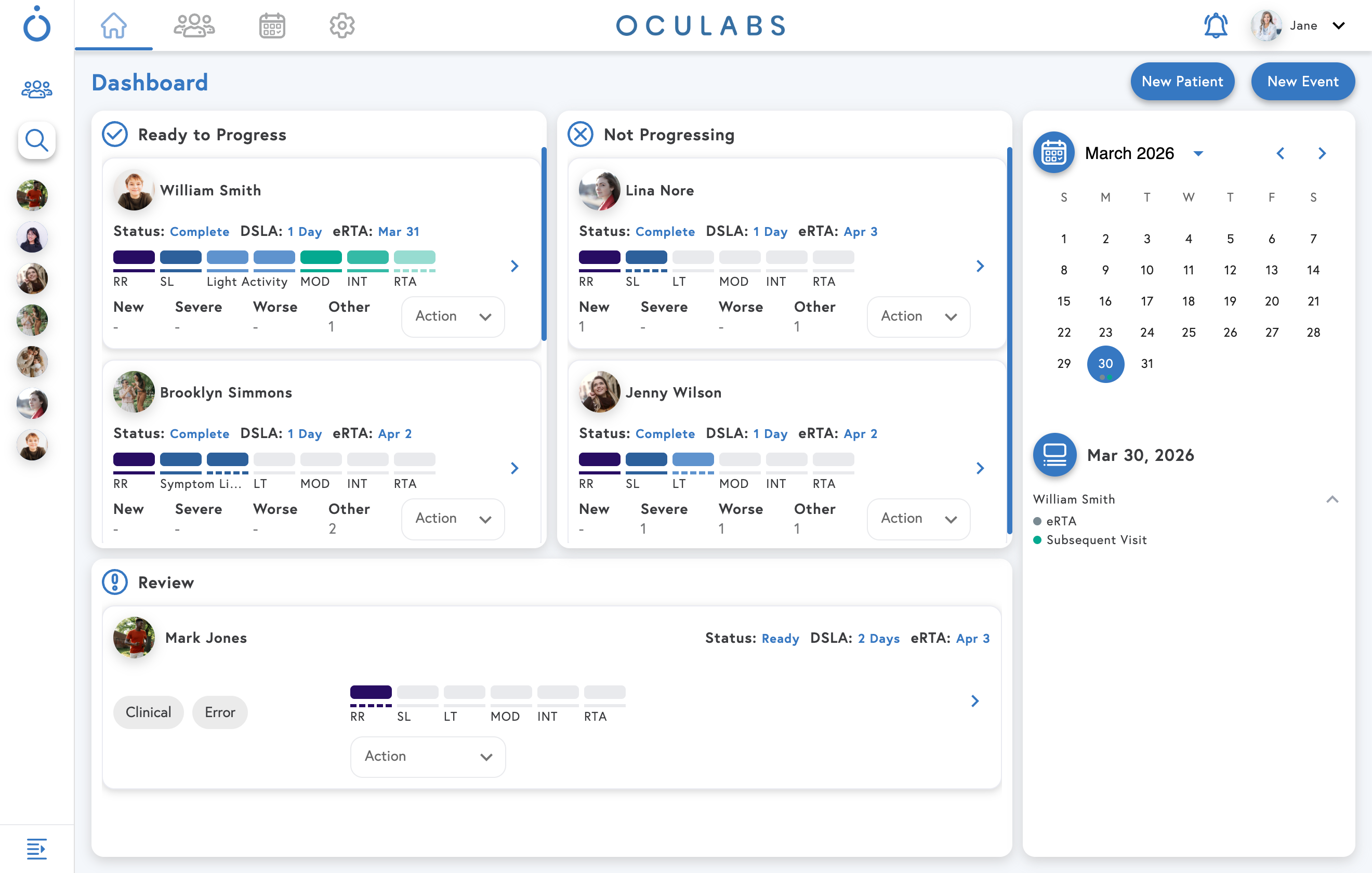
Software does not make those decisions. It should surface who is drifting, put the history in front of the clinician, and get out of the way. The clinician decides. What a platform can honestly promise is that nobody quietly disappears between appointments.
That is the part of concussion care that has been missing, and it is not a measurement problem. It is a follow-through problem.
See how a protocol runs end to end
Oculabs is a concussion recovery platform where clinics build their own protocol and track recovery visit over visit. We are happy to walk through it.
Request a demo- Brain Injury Association of America, 2026 State of Brain Injury Report.
- Silverberg ND, Iverson GL, et al. The American Congress of Rehabilitation Medicine Diagnostic Criteria for Mild Traumatic Brain Injury. Archives of Physical Medicine and Rehabilitation, 2023. doi:10.1016/j.apmr.2023.03.036
- Commission on Accreditation of Rehabilitation Facilities, Concussion Rehabilitation Program accreditation standards.