Picture two athletes hit in the same game. Both are awake and talking on the sideline. Both know where they are. Both would score 15 out of 15 on the Glasgow Coma Scale, so by the usual definition both have a mild traumatic brain injury.
One is symptom-free in ten days. The other is still having headaches and falling behind in class months later. Their charts carry the same word.
Where the word comes from
Mild, moderate and severe are cut points on the Glasgow Coma Scale sum score. A score of 13 to 15 is mild, 9 to 12 is moderate, and 3 to 8 is severe. The scale describes level of consciousness, and trauma centers have relied on it for more than 50 years.
For the two athletes in that opening scene, the score records that they were awake and responsive in the first hours. It tells the clinician very little about the weeks that follow.
What the recovery data show
The TRACK-TBI study followed 1,154 patients with mild TBI who came to 11 US level I trauma centers between 2014 and 2018, all with admission scores of 13 to 15. A comparison group of 299 patients had orthopedic injuries and no head injury. Researchers measured daily function with the Glasgow Outcome Scale Extended, where any score below the top score of 8 means some injury-related limitation.
Two weeks after injury, 87 percent of the mild TBI group reported some limitation. At 12 months, 53 percent still did. In the orthopedic group the 12-month figure was 38 percent.
Those numbers need care. These were trauma-center patients, older and more varied than a typical school or college sports population. The orthopedic group also shows that a lot of lasting limitation after any injury has nothing to do with the brain. Even so, the authors concluded that most of their mild TBI patients reported injury-related difficulties a year later, and they called for more systematic follow-up.
A single label that covers a patient who recovers in a week and a patient who is still limited a year later carries very little information about either of them.
The field has been saying this for a while
In 2022 the National Academies of Sciences, Engineering, and Medicine published a report on traumatic brain injury that called the three labels outdated and imprecise. It warned that the classification can bias care, because a patient labeled mild who has lasting symptoms may have treatment stopped too early. It asked that brain injury be treated as "an evolving condition that may have long-term effects," with assessment and treatment adjusted as a person's status changes.
The same year, the National Institute of Neurological Disorders and Stroke launched an international effort to build a replacement. Six working groups with 94 participants from 14 countries took part: brain injury experts, implementation scientists, federal partners and people with lived experience of brain injury. Their proposal was published in The Lancet Neurology in 2025.
What CBI-M proposes
The framework is named CBI-M after its four pillars, which are meant to be assessed together.
- Clinical. The full Glasgow Coma Scale, with its eye, verbal and motor responses recorded, plus pupil reactivity. The Brain Injury Association of America's summary notes that this pillar also covers amnesia and symptoms such as headache, dizziness and noise sensitivity.
- Biomarker. Blood-based measures that give objective signs of tissue damage. Low levels can help identify patients who do not need a CT scan.
- Imaging. CT and MRI findings such as bleeding and lesions.
- Modifiers. What the patient brings to the injury: age, sex, preexisting conditions, medications, earlier brain injuries, mental health history and access to care.
The modifiers pillar will look familiar to anyone who runs a concussion clinic. Prior concussions, other health conditions and whether a family can get a student to follow-up appointments are things many clinicians already ask about at intake. CBI-M moves them out of the history section and into the description of the injury itself.
What it does not do yet
The authors are plain about the limits. CBI-M describes the acute phase of injury. The research priorities they list are validating the framework, testing whether it applies beyond the acute phase, and working out how to put it into routine care. Dr. Manley, the paper's first author, described it to the BIAA as the first iteration.
So there is no new scoring sheet for a clinic to adopt this week. The direction is still clear. A single word assigned in the first hours is giving way to a fuller description that changes as the patient does.
What a clinic can take from it now
- Read the label for what it is. A mild classification describes level of consciousness in the first hours. It makes no prediction about how long recovery will take.
- Record the modifiers at intake. Prior concussions, other health conditions, medications, and anything that will make follow-up hard, kept in the same record as the scores.
- Measure the same things again. If the condition evolves, its description has to be updated, and that only happens when someone repeats the same assessments at each visit and reads them side by side.
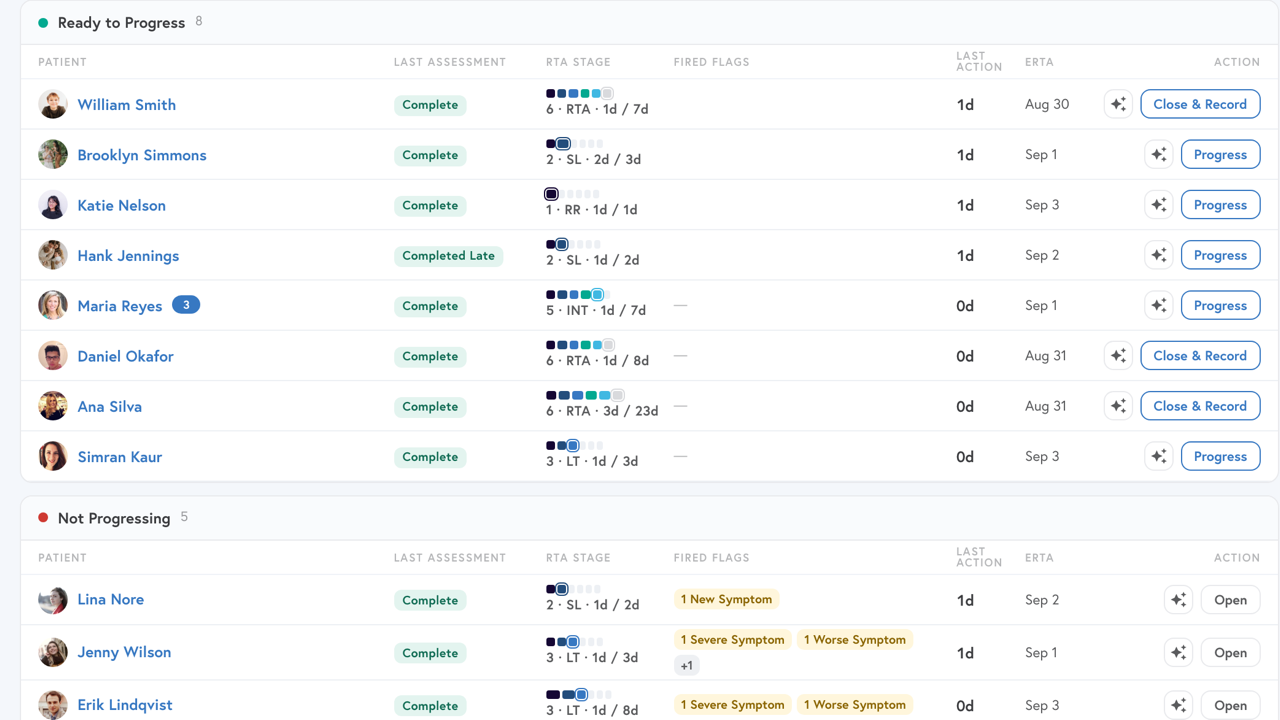
That last habit is where software helps. Oculabs keeps every assessment for a patient in one record, read visit over visit, and its decision support engine suggests who may be ready to progress, who is not progressing and who needs review. The clinician makes every call. Two patients who start with the same label should not stay hidden behind it once their recoveries begin to differ.
This article is general information for clinicians and program leads. It is not medical advice about any individual patient.
See recovery as a trajectory
Oculabs is a concussion recovery platform where clinics build their own protocol and track recovery visit over visit. We are happy to walk through it.
Request a demo- Manley GT, Dams-O'Connor K, Alosco ML, et al. A new characterisation of acute traumatic brain injury: the NIH-NINDS TBI Classification and Nomenclature Initiative. The Lancet Neurology, 2025;24(6):512–523.
- Nelson LD, Temkin NR, Dikmen S, et al. Recovery after mild traumatic brain injury in patients presenting to US level I trauma centers: a TRACK-TBI study. JAMA Neurology, 2019;76(9):1049–1059.
- National Academies of Sciences, Engineering, and Medicine. Traumatic Brain Injury: A Roadmap for Accelerating Progress, 2022, and the accompanying news release, "Traumatic Brain Injury Categories Should Be Updated and Personalized to Better Guide Patient Care, Says New Report."
- Brain Injury Association of America. Better Care, Better Outcomes: New TBI Characterization System Aims to Improve Diagnoses and Treatment.