A 2018 study in Archives of Physical Medicine and Rehabilitation took 11,907 children, aged 3 to 16, who had come to hospital emergency departments with a head injury, and applied 17 published definitions of mild traumatic brain injury to the same dataset.
Depending on the definition, the share of those children classified as having a mild TBI ran from 7.1 percent to 98.7 percent. Same children, same injuries, same charts.
That is the problem the American Congress of Rehabilitation Medicine set out to fix.
Where the definitions came from
The ACRM published a definition of mild TBI in 1993. It was widely used and, over thirty years, widely adapted. By the time the task force began its revision the original had been succeeded by a range of other criteria, and the University of British Columbia's announcement of the new version put the consequence plainly: a patient's diagnosis now depends on the criteria being used.
The 2023 revision was built to hold across settings. The task force convened a working group of 17 and an external panel of 32 clinician-scientists, ran rapid evidence reviews on 12 clinical questions, took public feedback from 68 individuals and 23 organizations, and voted in three Delphi rounds. The final agreement rate on the criteria was 90.7 percent. They are intended for use across the lifespan and in sports, civilian trauma and military settings.
What the criteria require
The paper itself sits behind a journal paywall. The summary below follows the open-access description by Sergeyenko and colleagues in Current Pain and Headache Reports (2025), which reproduces the structure.
The diagnosis starts with a plausible mechanism of injury: the head struck by an object, the head striking something, acceleration and deceleration forces acting on the brain, or blast exposure. That criterion is necessary. From there, one of three routes has to be satisfied.
- One or more clinical signs attributable to the injury: loss of consciousness, an alteration of mental status immediately after the injury, post-traumatic amnesia, or another acute neurological sign such as a seizure or observed motor incoordination.
- Or two or more acute symptoms, together with at least one finding on clinical examination or laboratory testing. The symptoms are the familiar ones: feeling dazed or confused, headache, nausea, dizziness, vision problems, sensitivity to light or noise, brain fog, memory and concentration problems, irritability. The findings are cognitive, balance or oculomotor impairment on acute examination, or an elevated blood biomarker indicating intracranial injury.
- Or evidence of TBI on CT or MRI.
Finally, the positive findings must not be better accounted for by something else: a pre-existing or co-occurring condition, intoxication or medication, an acute stress reaction, syncope before a fall, or symptom exaggeration. That exclusion is also necessary.
To count as mild, loss of consciousness has to be under 30 minutes, the Glasgow Coma Scale score at least 13, and post-traumatic amnesia under 24 hours. The criteria also define a category of suspected mild TBI for cases where information is missing or unclear, so that a person can be managed as if injured while the diagnosis stays honest about its uncertainty. And the expert panel settled a vocabulary question that has caused confusion of its own: 30 of the 32 agreed that concussion may be used interchangeably with mild TBI when neuroimaging is normal or not clinically indicated.
The part that changes practice
Read the second route again. Two symptoms on their own meet nothing. Two symptoms plus a finding meet the criteria. A headache and a feeling of fog after a collision, with nothing examined and nothing written down, is a story. The same presentation with a documented balance deficit, or an abnormal response to vestibular-oculomotor testing, is a diagnosis.
That shifts work onto the acute visit. Somebody has to examine cognition, balance and eye movement, and record what they found and when. The criteria also draw a line between what was observed and what was reported. Loss of consciousness that a bystander saw is a clinical sign. Feeling dazed, as the patient describes it afterwards, is a symptom. They sit in different criteria and carry different weight, and most charts do not separate them.
The third piece is the exclusion. The clinician has to consider, and ideally note, what else could explain the picture. The team that later built a structured interview for the criteria wrote, discussing military settings that use the VA/DoD criteria, that routinely applying the confounding-factors criterion, and keeping observed signs separate from reported symptoms, would be an advance for clinicians and researchers.
A structured interview, and what it costs in time
In September 2023 the task force started a project to turn the criteria into an interview. Two project leads drafted it, 17 task force members revised it over three rounds, 19 outside experts reviewed it, and 11 interviewers field-tested it across 25 diagnostic interviews. The result, published in the Journal of Neurotrauma by Lange, Gillow and colleagues (online November 2025), is five documents: the interview, an administration guide, a diagnostic coding form, a diagnostic flow diagram, and a short form for settings where the full interview is not feasible.
The field-testing numbers, presented at the Military Health System Research Symposium, are worth knowing before adopting it. Administration took 28 minutes on average, with a range of 15 to 40, and interviewers who had done it three or four times were at the fast end. Of the external reviewers, 89 percent said they would use the interview as a research tool. As a clinical tool, 47 percent said they would use it, and the most common reason for hesitation was the time it takes. The authors also note that there are no published psychometric data yet to support its clinical use, and that data collection is in progress. It is a careful tool with its evidence still arriving.
The interview covers a single injury event. It is not a lifetime TBI history tool, and its authors say so.
What a clinic can take from it now
The criteria are already headed into guidelines and accreditation. CARF's concussion rehabilitation program standards, the first written for concussion programs, appear in the 2024 medical rehabilitation standards manual with accreditation available from July 2024, and the University of British Columbia's announcement of the criteria said the goal is adoption into clinical practice guidelines, accreditation standards and eventually electronic medical records.
None of that requires a clinic to wait. Four habits put a program ahead of it.
- Record the mechanism, in the patient's words and the clinician's. It is the one criterion every diagnosis needs, and the easiest to leave implicit.
- Keep observed signs apart from reported symptoms. Who saw the loss of consciousness, and for how long, is a different line in the record from how the patient felt an hour later.
- Examine, and write down the result, even when it is normal. A balance screen, a cognitive screen and vestibular-oculomotor testing on the first visit are what make two symptoms a diagnosis. The same screens, repeated the same way at later visits, are what show recovery.
- Note what else was considered. A line on confounders at the time of diagnosis is worth more than a reconstruction months later, when a school, an employer or an insurer asks.
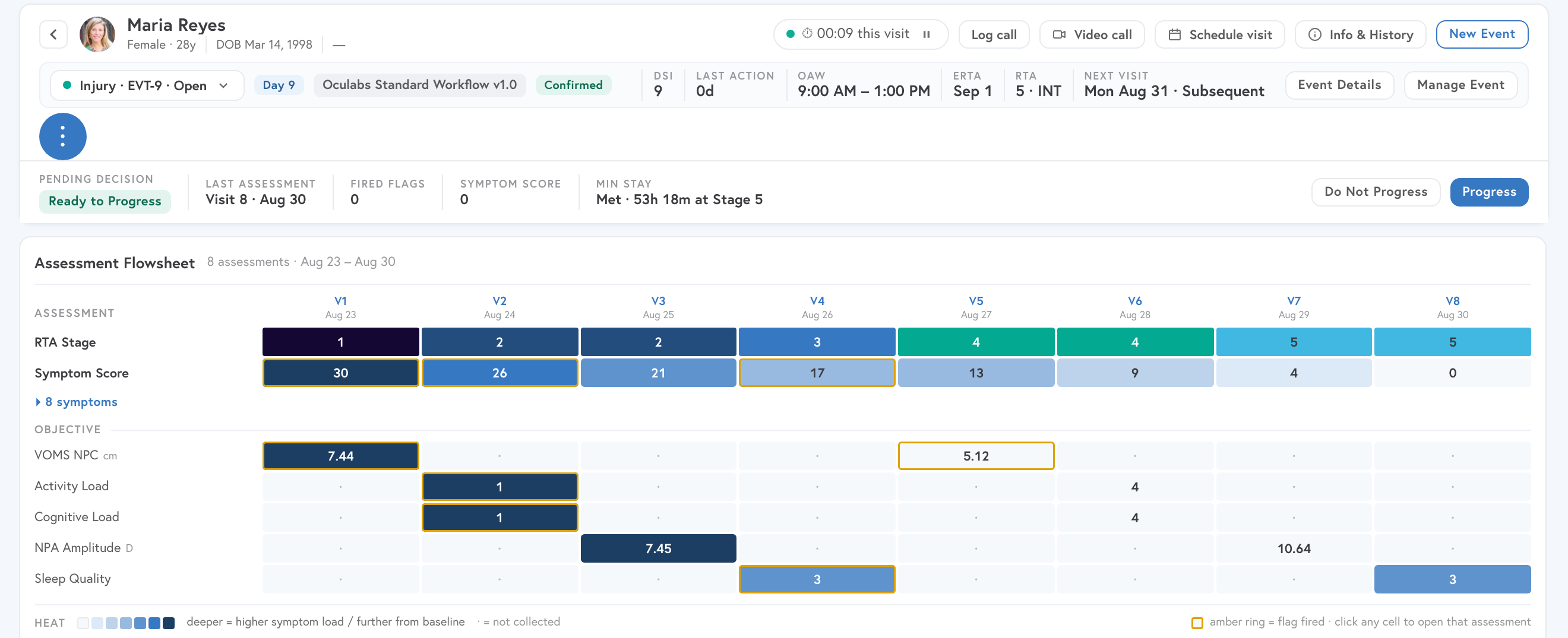
The diagnosis is a moment. The record it starts is what the recovery gets measured against, and that is where software has a job. Oculabs is built so a clinic runs its own protocol and the same assessment battery at every visit, with the symptom inventory, VOMS, balance and cognitive screens kept together on one timeline. Its decision support engine suggests who may need a closer look. The clinician makes every call, including the diagnosis itself.
This article is general information for clinicians and program leads. It is not medical advice, and the diagnosis of any individual rests with the treating clinician.
See what the record looks like
Oculabs is a concussion recovery platform where clinics build their own protocol and track recovery visit over visit. We are happy to walk through it.
Request a demo- Silverberg ND, Iverson GL, and the ACRM Brain Injury Special Interest Group Mild TBI Task Force and Expert Consensus Group. The American Congress of Rehabilitation Medicine Diagnostic Criteria for Mild Traumatic Brain Injury. Archives of Physical Medicine and Rehabilitation, 2023;104(8):1343–1355. doi:10.1016/j.apmr.2023.03.036
- Crowe LM, Hearps S, Anderson V, et al. Investigating the Variability in Mild Traumatic Brain Injury Definitions: A Prospective Cohort Study. Archives of Physical Medicine and Rehabilitation, 2018;99(7):1360–1369.
- Sergeyenko Y, Andreae ME, Segal M. Diagnosis and Management of Mild Traumatic Brain Injury (mTBI): A Comprehensive, Patient-centered Approach. Current Pain and Headache Reports, 2025. Open access; summarizes the 2023 criteria.
- Lange RT, Gillow KC, and the ACRM Brain Injury Special Interest Group Mild TBI Task Force. Development of a Structured Interview for the American Congress of Rehabilitation Medicine Diagnostic Criteria for Mild Traumatic Brain Injury. Journal of Neurotrauma, 2026;43(11–12):934–943, online November 2025. doi:10.1177/08977151251396077
- Lange RT, Gillow KC, et al. Poster of the same title, Military Health System Research Symposium (field-testing results).
- University of British Columbia Faculty of Medicine. International group of experts redefines concussions. News release, 5 June 2023.
- Giza C, Gioia G, Yochelson M, Carolan T. Dispatches from the Concussion Field: ACRM's Revised Mild TBI Diagnostic Criteria and CARF International's New Concussion Rehabilitation Program Accreditation Standards. American Academy of Neurology 2024 annual meeting abstract.